Official Records of Shell-shock
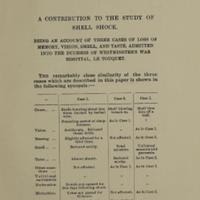
Shell-shock did not exist as a documented category of disability until February 1915, when psychologist Charles Myers published a paper in The Lancet entitled “A Contribution To The Study of Shell Shock: Being An Account of Three Cases of Loss of Memory, Vision, Smell, and Taste.” During his work as a military doctor in France and as a specialist commissioned by the Royal Army Medical Corps (RAMC), Myers observed and recorded the symptoms of patients who had diminished sensory functions and memories (Myers 317-318). Men suffered from a range of symptoms, including fatigue, poor sleep, nightmares, jumpiness, and somatic pain and disabilities (Jones and Wessely 23).
Myers tentatively associated these symptoms with the shock of falling shells, but was cautious to avoid assigning any definitive answer for these symptoms, though he surmised, “The close relation of these cases to those of ‘hysteria’ appears fairly certain” (320). Myers adopted the term ‘shell-shock” from the parlance of soldiers: his study brought the term into institutional use.
The term “shell-shock” came to reference a form of war trauma, both physical and mental: whether its origin was based on "commontional" trauma or mental trauma was debated well after the end of the First World War.
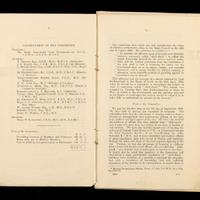
In June of 1922, the War Office Committee of Enquiry published their report on shell-shock and its treatment during the Great War. In 1922, the term which the War Office Committee references most often is war neurasthenia, or simply neurasthenia. The Report of the War Office Committee is an apt example of the controversial nature of shell-shock: throughout its pages, the term is lambasted as an ineffectual means of describing the traumatic effects of war.
In 1980, the American Psychological Association would add Post-Traumatic Stress Disorder (PTSD) to the third edition of the Diagnostic and Statistical Manual of Mental Disorders. Like PTSD, shell-shock describes a traumatic event, but unlike shell-shock, PTSD references traumatic contexts beyond combat and war. As we examine shell-shock within the context of the First World War, it is important to remember that this diagnosis was primarily applied to men, whereas women would be more likely to be diagnosed with hysteria, meaning that shell-shock exists within the historical record as a diagnosis which is primarily gendered as male.
While the purported purpose of the report is to describe subject of war neurasthenia and its proper diagnosis and treatment, it also responds to worry among the families of shell-shocked men, who brought forth complaints of military negligence in treating shell-shock cases. Its unstated primary purpose was to banish doubt in the government’s ability to address cases of trauma, on a public stage.