Topic Modeling Mary Borden's Novels
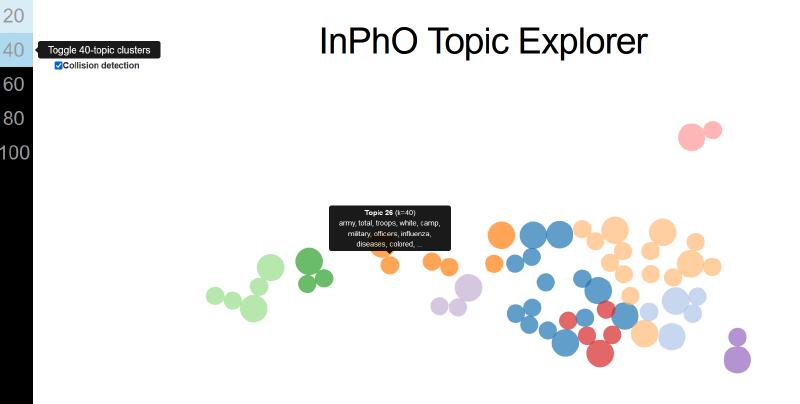
In this example using the InPhO Topic Explorer, I prepared a validated workset of seven novels from Mary Borden, including The Romantic Woman (1920) The Tortoise (1921), Jane: Our Stranger (1924), Three Pilgrims and A Tinker (1928), Journey Down A Blind Alley (1946) Margin of Error (1954), and The Hungry Leopard (1956). I increased the number of instances which the InPhO Topic Explorer would query to 400, as an increased number is preferred for accuracy. After running the topic explorer, I restricted the explorer to twenty topics.
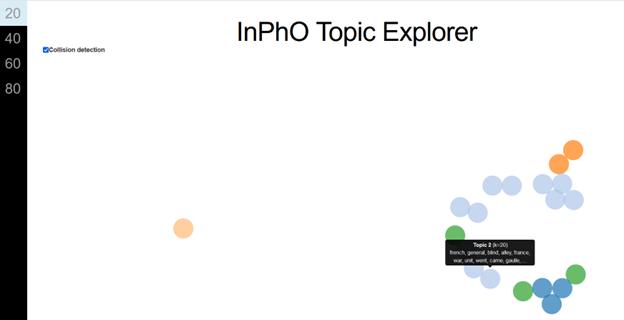
The twenty-topic cluster returns a number of terms related to Borden's experience of war, such as “french,” “general,” “british,” “hospital,” and “unit,” indicating that there is a high proportion of Borden’s seven novels (as represented in this small-scale corpus) which deal with war.
Notably, since I was restricted to open-access works, this corpus did not include her work which deals most readily with her war experiences, The Forbidden Zone, which is not in the public domain since it was republished.
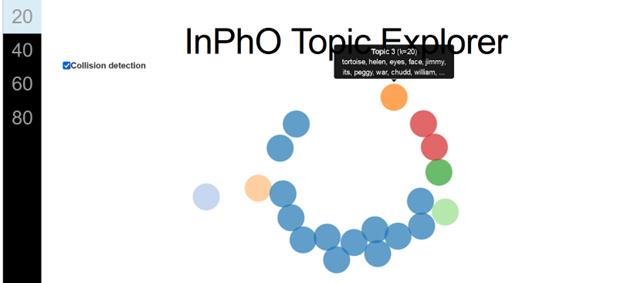
The term “war” is also given similarity with one of the unique topic categories, but is included alongside major character names such as Jimmy, Peggy, William, Helen, and Chudd, but also the word “tortoise,” which appears multiple times at the header of every page. In the Borden corpora, character names were so prevalent that they should have been incorporated into a stopword list in order to provide a more meaningful topic model.
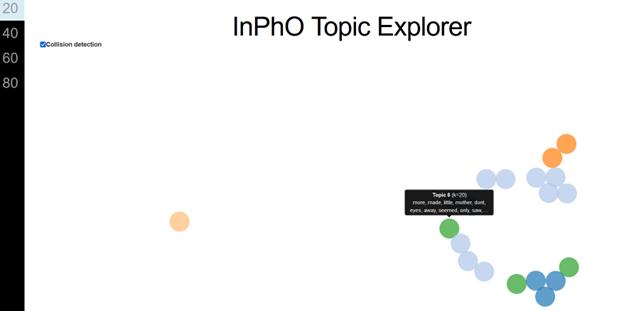
Throughout, Borden’s writing references more gendered terms overall than the corpus of war poetry, as she references “mother,” “father,” “man,” and “woman” across 8 of the 20 meaningful topic categories. She also uses “herself,” which does not appear in the war poetry collection. In comparison, this similarly small corpus of war poetry collections (8 volumes in the war poetry collection, 7 volumes in the Borden collection) uses “he” more often than Borden does, and also uses archaic forms of personal address such as “thy” and “thee” to address the reader.
The majority of the words which appear in the War Poems model reference setting, such as “sea” and trench,” while the topic model of Borden’s novels indicates that characters take up more space.
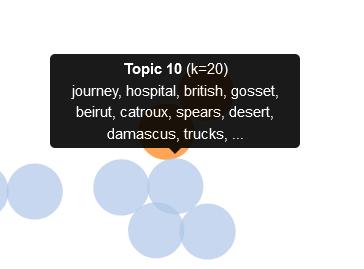
When Borden references setting, she is much more likely to employ geographical specificity, rather than more geographically ambiguous settings in war poetry, as seen here, when her topic model summons “journey,” “hospital,” “beirut,” and damascus” to stand alongside one another in the same category. I chalk this up to the subject geography of the war: for Borden, she remembers the war as movement from hospital to hospital, and for war poets, the war becomes the trench itself, which is “dark” and fearful.