Topic Modeling War Poetry
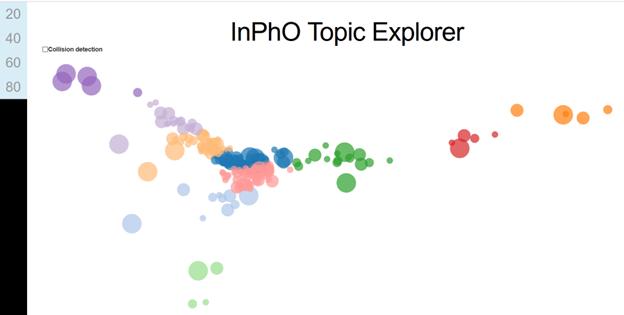
This is a topic model of 8 volumes of war poetry, providing the model with 400 iterations, and a k value of 80. Topics were sorted by color and by usage, with a k-20 allocation meaning that a term occurred more predictably than a k-80 allocation.
Volumes include Rupert Brooke’s collected works, published posthumous under the title Rupert Brooke (1925), World War Poems (1918) by Moses Weldon Sowards, Poems by Wilfred Owen (1920), two volumes of poetry by Siegfried Sassoon, including Counter-attack and Other Poems (1919) and A Suppressed Poem (1919), Poems of Peace and War by Elizabeth Connor, Poems By Isaac Rosenberg (1922), and Pens for Ploughshares: A Bibliography of Creative Literature That Encourages World Peace (1930).
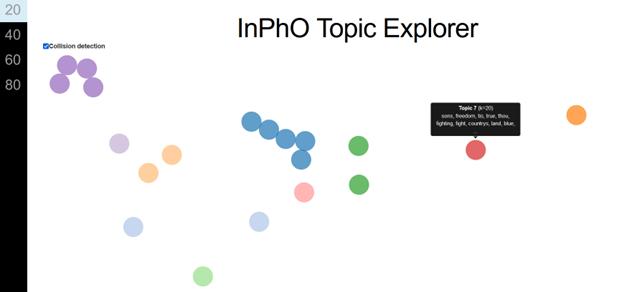
Throughout this topic model, I isolated items with a k-value of 20 for greater similarity, and turned on collision detection. Colored circles with different shades indicate a term is more of an outlier than colors with similar shades grouped together.
In the example of the red dot, we see that words like "sons," “freedom,” “fighting,” “fight,” “countrys,” and “land” are grouped together, which we might assign to a topic like “patriotism.”
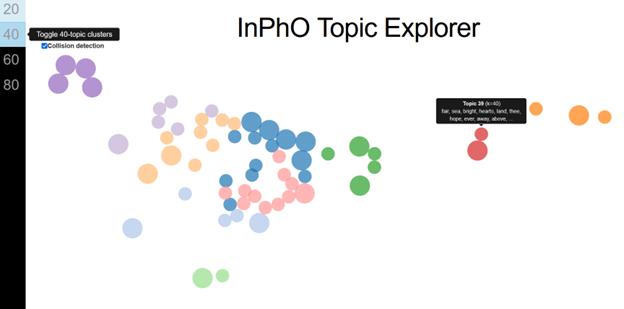
Expanding to clusters of k-40, I am able to isolate the most uniquely clustered terms. Expanding out, the red cluster deals with evocative language, in which I class words like “fair, sea, bright, hearts, land, thee, hope.” These words all address the reader, describe positive attributes (fair, bright, hearts) or discuss natural themes (sea, land). These idealistic terms include patriotism, but surpass it.
Together, the red cluster could be sorted into their own category of evocative and idealistic language, which patriotic language also evokes.
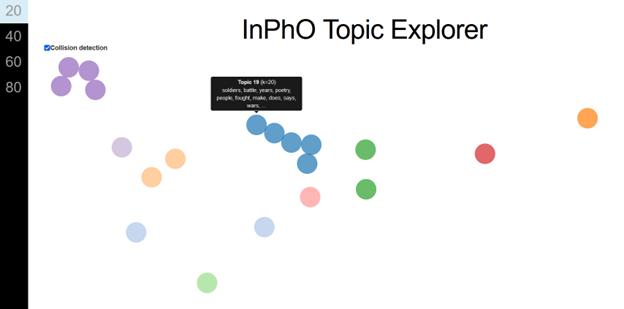
Grouped together in this blue cluster, we see “soldiers,” “battle,” “fought,” and “wars.”
Again, expanding out to the k-40 level, the topic model produces results which are similar but not identical in meaning. In a nearby topic cluster, “beauty” sits, uncomfortable, next to terms such as “naked,” “trench,” and “dark.”
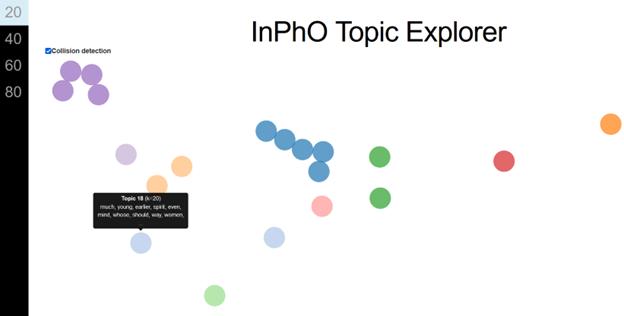
But if we return to the k-20 level, these confusing topic arrangements are slightly less confusing. “Hearts” and “beauty” and “music” are all in the same category, while “women,” “young,” “spirit,” and “mind” are all placed into the lavender category, an intriguing appearance of gender. (Notably, the analogous term “men” does not appear, except for the term “sons,” which is lumped together in the patriotic topic, while “women” appear in the same topic cluster as “young.” Given that the role of the war hero is a gendered role, this topic model seems to reveal some potential directions for scholars of gender and war poetry.