Browse Items (31 total)
Sort by:
The Hydra: Magazine of Craiglockhart War Hospital, December 1917

The Hydra was launched in April 1917 and stopped publication in 1918, serving as a hospital magazine for the soldiers at Craiglockhart Hospital. Wilfred Owen served as one of its editors, while Siegfried Sassoon's poems "Break of Day" and "Base…
Song of the Mud

Published in Current Opinion in 1917, Mary Borden wrote of her experiences as a woman at war in her poem "The Song of the Mud." Throughout the poem, Borden enumerates the various qualities of mud, an environmental threat on the battlefield of war,…
Keep smiling! : More news by Liarless for German homes

The following item shows a pictorial comic, featuring two men standing in the foreground, while the background features a green wall with a black door in it. On the wall, a sign reads, "Bones Broken While You Wait." One man uses crutches, while the…
The Shell-shock Shake

This piece of ragtime music satirizes the stereotypic movements of those diagnosed with shellshock. For voice and piano.
The lyrics of this musical arrangement reads thus:
Verse 1:Over there, somewhere in France, our boys have learned a brand-new…
The Rear-Guard

In April 1917, Sassoon’s company with the Royal Welsh Fusiliers supported a French assault on the supposedly secure German defenses, known as the Hindenburg Line. His 1917 poem “The Rear-Guard (Hindenburg Line, April, 1917)” is based upon this…
Strange Meeting

Wilfred Owen’s poem portrays two speakers meeting in “some profound dull tunnel, long since scooped / Through granites which titanic wars had groined” (2-3). This granite tunnel is the aftermath of titanic wars, an image which reflects afterlife as…
Repression of War Experience

In his poem "Repression of War Experience," Siegfried Sassoon uses a metaphor of moths, who "blunder in," only to "scorch their wings with glory, liquid flame," like soldiers who believed that they would prove themselves heroes through war. Like…
Break of Day in the Trenches

This draft of Break of Day In the Trenches was typed and set by Annie Rosenberg, possibly in June, while Isaac Rosenberg created the written annotations, likely in July.
Rosenberg’s earlier poetry betrays his Romantic influences. In “Break of Day…
Rosenberg’s earlier poetry betrays his Romantic influences. In “Break of Day…
The Repression of War Experience
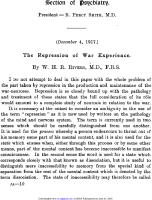
In this speech, given in front of the Royal Society of Medicine, Rivers explains the process of being shell-shocked as repression, a means of obscuring mental content from memory and rendering memory inaccessible. However, when trauma was…